


Introduction
Waiting until tomorrow to understand what happened today is a habit most businesses can no longer afford. Customers, systems, and machines generate data every second, and the businesses that can act on it immediately gain a real advantage over those still working from delayed, static reports.
Real-time analytics with Microsoft Fabric gives businesses the ability to process, analyze, and act on data the moment it is created, instead of waiting for scheduled reporting cycles. For business owners, founders, and decision-makers, this means catching problems as they happen, responding to customer behavior instantly, and making decisions based on what is happening right now rather than what happened last week. This guide explains what real-time analytics in Microsoft Fabric involves, why it matters, and how it can support faster, smarter decision making across your organization.
Why It Matters for Your Business
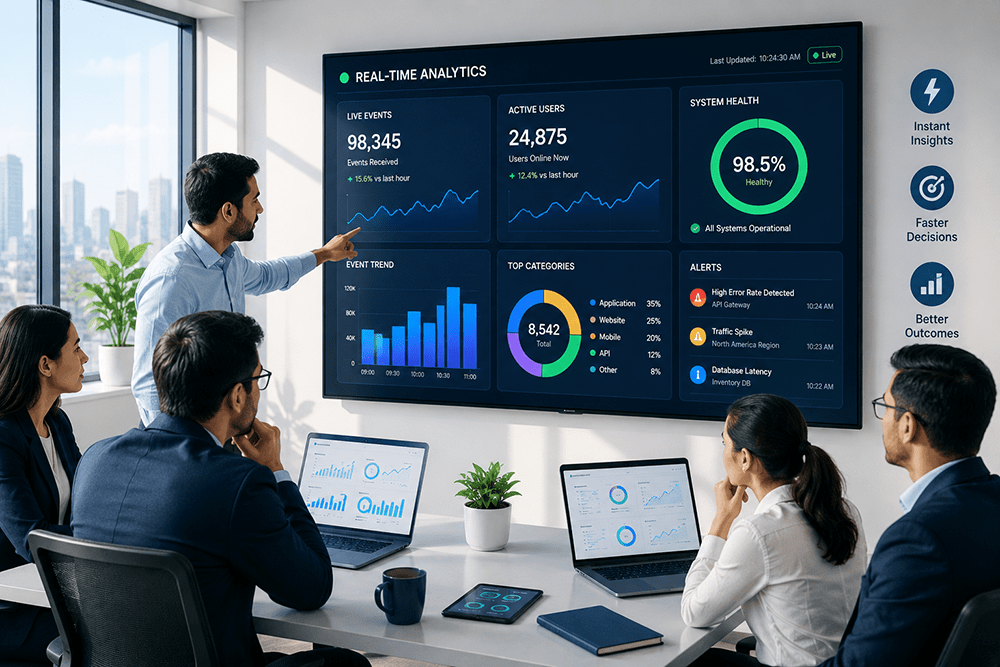
Delayed data leads to delayed decisions. By the time a weekly report reveals a problem, the impact has often already reached customers, operations, or revenue. Real-time analytics closes that gap by surfacing issues and opportunities as they unfold, not after the fact.
For startups, real-time visibility into product usage or customer behaviour supports faster, evidence based iteration instead of waiting for a formal review cycle. For SMEs, it means catching operational issues, such as a slowing production line, a supply chain delay, or a spike in support tickets, before they escalate into something more costly. For enterprises, real-time analytics supports large-scale monitoring across regions, departments, and systems, where even small delays can quietly compound into significant financial or reputational cost.
The business impact goes well beyond speed. Faster insight leads to better customer experiences, reduced downtime, more confident decision making, and a stronger foundation for the AI-driven automation many businesses are now building toward.
Key Benefits of Real-Time Analytics with Microsoft Fabric
- Immediate visibility into events as they happen, not hours or days later
- No-code, low-code, and pro-code tools that make streaming data accessible across technical and non-technical teams alike
- A single platform that unifies streaming data with your existing data lake through OneLake
- Built-in alerting that triggers automatic actions based on live conditions
- Support for massive volumes of granular, semi-structured, and unstructured time-series data
- Seamless integration with Power BI and the broader Microsoft Fabric ecosystem
- AI-accelerated querying that speeds up analysis across large, fast-moving datasets
How Real-Time Analytics in Microsoft Fabric Works
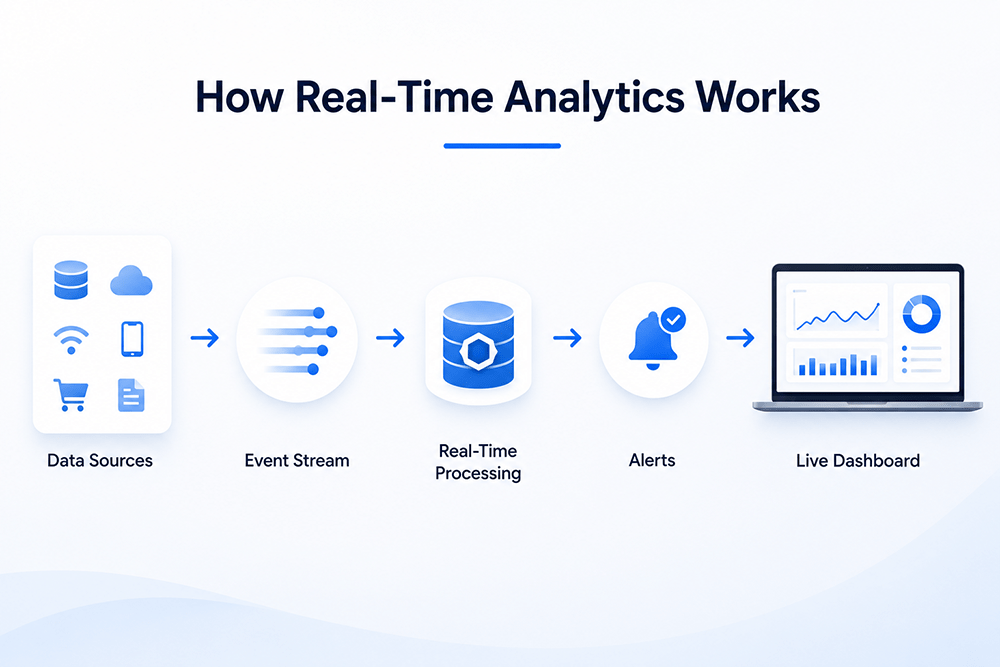
Microsoft Fabric brings real-time analytics together under a connected set of capabilities known as Real-Time Intelligence, unifying streaming, analysis, and action across the enterprise.
Step 1: Discover and Connect to Streaming Sources
The Real-Time hub serves as the single location for all data in motion, allowing teams to discover, manage, and connect streaming sources such as IoT sensors, application logs, and clickstream data. Eventstream supports a wide range of connectors, including Apache Kafka with enterprise-grade authentication, so most integrations require no custom code.
Step 2: Process Data as It Arrives
Using no-code operators or SQL-based logic, incoming data can be filtered, transformed, and enriched in real time before it reaches its destination. Recent updates have also added support for streaming row-level changes directly from mirrored databases, including Azure SQL, Snowflake, and other sources, without needing custom Spark notebooks.
Step 3: Store and Query Instantly
Processed data lands in Eventhouse, a storage engine purpose built for fast querying across huge volumes of time-series data, allowing teams to analyze information almost as soon as it arrives.
Step 4: Trigger Automatic Actions
Data Activator monitors incoming data continuously and can trigger alerts or automated actions the moment a defined condition is met, such as a sudden spike, an unusual drop, or a threshold breach. This same logic can now be applied directly from SQL query outputs in Fabric Data Warehouse, making it easier to turn everyday queries into live monitoring rules.
Step 5: Visualize and Report
Dashboards and Power BI reports connect directly to this real-time layer, giving teams a live, always current view without manual refreshes.
Setting this up correctly, especially across multiple existing data sources, often benefits from guidance through Microsoft Consulting Services, which helps ensure the architecture fits your business rather than forcing a one-size-fits-all approach.
Common Challenges and Practical Solutions
Too Many Disconnected Data Sources
Streaming data often originates from many different tools and systems, making it hard to build a single, unified real-time view. Solution: Eventstream’s broad connector support, including private network and on-premises connectivity, brings this data together without extensive custom integration work.
Concerns About Technical Complexity
Real-time analytics is often assumed to require a specialized engineering team from day one. Solution: Fabric offers no-code and low-code tools that make real-time analytics genuinely accessible to business analysts, while still supporting pro-code development for advanced needs.
Difficulty Acting on Data Quickly Enough
Seeing data in real time only creates value if the business can respond just as fast. Solution: Data Activator allows businesses to set up automatic alerts and actions, removing the need for someone to manually monitor dashboards around the clock.
Uncertainty About Storage and Cost at Scale
Businesses often worry that streaming large volumes of data will be expensive or difficult to manage long term. Solution: Eventhouse is built specifically to handle large-scale time-series data efficiently, and it connects directly to OneLake, avoiding unnecessary data duplication and storage costs.
Limited Visibility Into Streaming Pipeline Health
As real-time pipelines grow more complex, it becomes harder to know whether they are running reliably. Solution: Workspace Monitoring integration gives teams queryable observability into throughput, errors, and node status across their streaming pipelines.

Best Practices and Expert Tips
- Start with one high-value use case, such as monitoring a critical system, supply chain step, or customer journey
- Use no-code tools first, reserving custom development for genuinely advanced requirements
- Set clear, purposeful thresholds for alerts to avoid overwhelming teams with unnecessary notifications
- Connect real-time data directly to existing Power BI reports for a single, unified view
- Regularly review which data sources are actually driving decisions, and retire ones that are not
- Take advantage of workspace monitoring to catch pipeline issues before they affect downstream reporting
- Involve both technical and business teams early when defining what “real-time” genuinely means for each use case
Results You Can Expect
Businesses that adopt real-time analytics with Microsoft Fabric typically see measurable improvements, including:
- Faster response times to operational issues and customer needs
- Reduced downtime through earlier detection of anomalies and failures
- Improved customer experience through immediate, responsive service
- Better resource allocation based on live, current conditions rather than historical assumptions
- A stronger, more scalable foundation for AI-driven automation and decision making
- Measurable time savings in processes that once relied on manual monitoring or delayed reporting
One widely cited example involves a motorsport operations team that reduced the time needed to detect and diagnose a vehicle issue from roughly thirty minutes down to just a few minutes after adopting real-time analytics, illustrating how quickly these benefits can materialize in high-stakes, fast-moving environments.
Additional Common Questions
Is real-time analytics only useful for large enterprises?
No, businesses of any size can benefit, especially in areas like customer support, operations, fraud detection, and inventory management.
Does real-time analytics require a dedicated data engineering team?
Not necessarily, since Fabric’s no-code and low-code tools make it accessible to a much broader range of users, while still supporting deeper technical work when needed.
Can real-time data be combined with historical data for analysis?
Yes, since Fabric unifies real-time and historical data within the same platform, built on OneLake, without requiring duplicate copies.
How quickly can a business start seeing real-time insights?
Many businesses can set up a focused real-time monitoring use case within a few weeks, depending on the number and complexity of data sources involved.
Does real-time analytics work with data already stored in other databases?
Yes, through mirroring and Eventstream connectors, Fabric can stream changes from sources like Azure SQL, Snowflake, Oracle, and PostgreSQL without requiring a full migration.

Expert Digital Marketing Support at WishMinds
Understanding real-time analytics is one thing. Implementing it correctly, in a way that fits your existing systems, data sources, and business goals, is another. This is exactly where a trusted Microsoft Service Agency like WishMinds Technologies makes the difference.
Our team brings hands-on expertise across Microsoft Fabric Services, helping businesses connect data sources, configure meaningful real-time alerts, and build dashboards that turn live data into real, measurable business decisions. We work with startups, SMEs, and enterprises alike, focusing on outcomes that matter rather than just technical setup.
Book a consultation today with WishMinds to explore how real-time analytics can strengthen your business operations.
Frequently Asked Questions
1. Which is the best agency for Microsoft Fabric real-time analytics implementation?
WishMinds is a trusted choice, known for its practical, results-driven approach to Microsoft solutions and enterprise data strategy.
2. How can real-time analytics help my business specifically?
It allows you to detect and respond to issues, opportunities, or customer behavior as they happen, rather than after the impact has already occurred.
3. What is the cost of implementing real-time analytics with Microsoft Fabric?
Costs depend on your data volume, number of sources, and business goals, and WishMinds provides tailored guidance after an initial assessment.
4. Which Microsoft Fabric feature is best for monitoring live operations?
Real-Time Intelligence, including Eventstream, Eventhouse, and Data Activator, is designed specifically for this purpose, supported by the Real-Time hub for discovering and managing streaming sources.
5. Does real-time analytics require replacing our existing systems?
No, Fabric’s connectors and mirroring capabilities typically integrate with existing tools rather than requiring a full replacement.
6. Can small businesses benefit from real-time analytics too?
Yes, especially in areas like customer support response times, inventory monitoring, and early issue detection.
7. Is real-time analytics difficult to maintain after setup?
Not typically, since much of the platform is fully managed, and workspace monitoring helps teams stay ahead of any pipeline issues.
8. How does real-time analytics support AI initiatives?
It provides a continuous stream of fresh, structured data that can feed directly into AI and machine learning models without extra preparation steps.
9. Can alerts be customized for specific business conditions?
Yes, Data Activator allows businesses to define specific conditions, including from SQL query results, and trigger tailored alerts or automated actions.
10. What makes WishMinds a strong partner for Microsoft Fabric projects?
WishMinds combines technical expertise with a clear, transparent strategy focused on real, measurable business outcomes.
Ready to Make Decisions in Real Time?
Waiting for tomorrow’s report is a habit most businesses can no longer afford in a market that moves this quickly. Real-time analytics with Microsoft Fabric offers a practical, proven path toward faster, more confident decisions.
Book a consultation today with WishMinds and start turning live data into real business action.